AI and control: people must be able to correct the system
Can the team stop the work order?
Made-up example · Technikumstrasse, Winterthur
Technikumstrasse has an old sewer. The AI suggests where to dig. The AI gets an update just before the team sends the order.
Two ways through the update
- Pause for the update: The order waits while the plan and the stop are missing.
- Keep going: The order keeps going. The team cannot stop it yet.
One way kept the order running when it could not be stopped.
The example shows the gap. It does not say if the work is delayed or what happens to the tree.
Using AI can change how well people can check its results and decide how it is used later.
Imagine an expert review team that uses AI recommendations. A person still approves every case. Formally, the team remains responsible. But can its members make their own judgement? Can they check the evidence, deal with disagreements and change the use of AI when necessary?
Path ethics asks how AI can support people while preserving their real ability to correct it. It looks at how a team continues through its own work, relationships and learning. It asks what AI use means for future decisions, as well as the decision being made now. (Foundational work)
One use, two possible effects over time
Open and enlarge the diagram as SVG
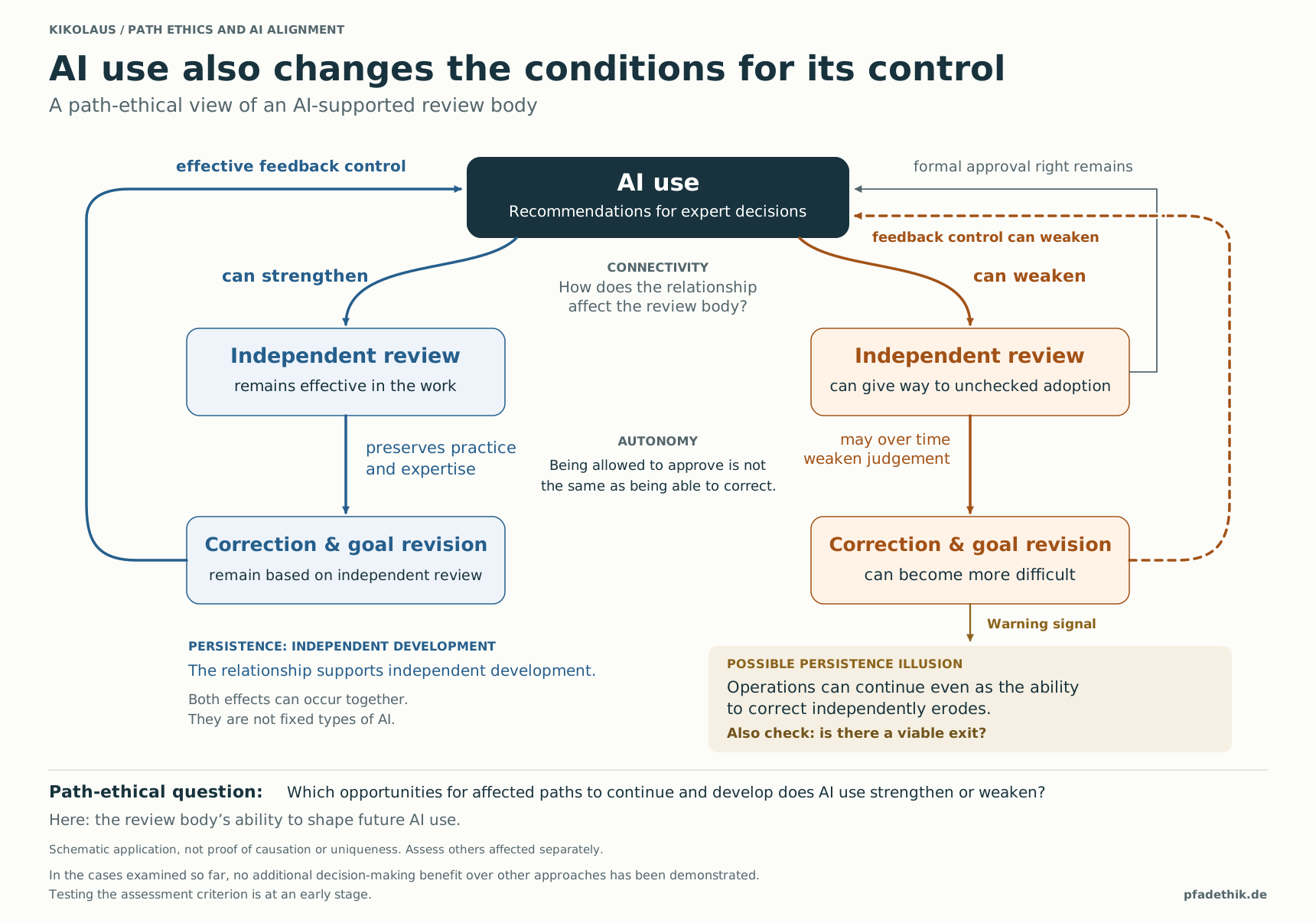
*A schematic application to a human review body. Both effects can occur together, across tasks or over time. They are not fixed types of AI or measured trajectories. The warning box signals a possible diagnosis; a viable exit still needs to be examined.*
How to read the diagram
On the left, the team keeps checking for itself. What it finds can lead to corrections and changes in the goals of AI use. The return arrow shows this influence. On the right, the team may stop checking and accept the AI output without review. The dashed orange arrow shows that actual influence over AI use may weaken. The thin grey arrow starts at the review practice and shows that the formal right to approve remains. Having a right does not prove that the conditions for exercising it responsibly remain intact. (Foundational work)
The lower right box warns about possible false stability: work continues, but the team may lose its ability to correct things on its own. To decide whether this is happening, we must also ask whether there is a workable way out of the dependence. (Foundational work, Path Impact Assessment)
What the feedback effect depends on
The effect depends on how people and AI work together. This thought experiment shows one thing that can be changed:
Two teams receive the same AI recommendation. They have the same skills, the same time to check and the same right to decide. Both may reject the recommendation. Team A can check the relevant information for itself. Team B sees only the recommendation. Their right to reject it is the same, but their basis for making a judgement is different.
This example shows one way to improve the process: give reviewers access to the information they need. The example shows one condition for independent review. It does not show that access alone guarantees good decisions, or that lack of access already proves a long-term loss of skill.
To understand what happens over time, we would also need to examine other conditions: do actual review practice and feedback on errors continue? Is there time to consider doubts? Can reasoned objections change the rules governing AI use? These are questions for investigation, not a tested formula for success. Automation research has long described the connection between practice, knowledge and the ability to intervene. (Bainbridge: Ironies of Automation)
Three perspectives on the same relationship
Autonomy: more than permission to approve
Here autonomy means that the team can help decide its work and its future. A formal right to act is called nominal autonomy. The real ability to decide for oneself is called structural autonomy. In the diagram the right to approve can remain while the ability to make reasoned corrections declines. (Foundational work)
Connectivity: the effect of the relationship
Connectivity concerns the relationship between the AI, the team and other people or systems affected. We ask which paths the connection strengthens and which it weakens. Dependency is not destructive merely because support comes from outside. The question is what the relationship enables and what it impairs. (Foundational work)
AI taking over an individual task can reduce workload. The question here is whether the practice on which independent review depends is maintained. (Path Impact Assessment)
Persistence: continuation through one's own development
Persistence means that a directed process continues over time. On the left is its positive aspect: the review body can process experience and develop its working methods. This is more than unchanged operation. On the right, the question is whether continuing operation conceals an erosion of the body's own capacity for renewal. (Foundational work)
The right-hand trajectory is therefore marked as a possible persistence illusion. The methodological discussion explains the further conditions for a diagnosis. (Foundational work, Path Impact Assessment)
From diagnosis to design
The diagram does not give a complete assessment of a change. The Path Impact Assessment asks three mandatory questions. Before applying them, the intervention and affected systems must be identified. In the diagram, the review body is the path considered and its AI-supported work is the change examined. (Path Impact Assessment)
Does the change support or replace the system’s own feedback? This means how the affected system deals with errors, regulates itself and develops. The question does not mean that AI oversight should always be reduced. Fixed rules can also help people correct mistakes. One example is a record of changes that cannot be altered. (Path Impact Assessment)
Which dependent systems lose stable conditions? Were they included in the decision? Affected people and systems need real influence. That influence should reflect how vulnerable they are, not how much power they have. Informing them is not enough. How to represent those who cannot speak for themselves remains an open question. (Path Impact Assessment)
Can the change be stopped or altered without dependent systems collapsing? An off switch alone does not answer this. It must be established how necessary services will continue if use ends or changes. The diagram does not show whether the review body has such an option. (Path Impact Assessment)
A practical aim follows: people must be able to correct the system in their real working conditions, not just have formal permission. Deciding which measures are suitable and proportionate also requires technical, organisational and ethical reasons.
A functioning review body is not enough
The diagram looks at only one relationship. A full assessment must look beyond it. In an imagined application procedure, the applicants whose cases are assessed would also be affected. A competent review body can operate a procedure reliably even when its goals or effects are indefensible towards those people.
Benefits for immediate users, effects on third parties and the justification of the goals must therefore be examined separately. Depending on the use, further institutions and ecological foundations of life also matter. The diagram does not decide whether artificial systems are owed protection in their own right, or whether their interests take priority in a conflict. (Foundational work, Path Impact Assessment)
Methodological discussion
Connectivity and intervention assessment
The diagram asks whether the relationship can strengthen or weaken the team’s own review. Connectivity analysis looks at the quality of the relationship. The Path Impact Assessment asks whether the change supports or replaces the named system’s own feedback. These questions are related, but they are not the same. Taking over one task alone does not prove that the relationship is harmful. (Foundational work, Path Impact Assessment)
When a warning becomes a diagnosis
A persistence illusion means that a system keeps going with outside support while losing its own ability to develop. The Path Impact Assessment identifies a warning signal when outside control replaces the system’s own feedback and there is no way out that avoids the collapse of dependent systems. The diagram does not examine whether such a way out exists. The box is therefore a warning to investigate further. (Foundational work, Path Impact Assessment)
One relationship, several perspectives
The three perspectives are not steps in time or separate sums of harm. One relationship may enable self-determination while also changing long-term dependence. Each effect must be justified. Colours distinguish directions of effect, while line styles and labels convey the meaning without reliance on colour. An overall judgement also requires assessing others affected and the goals.
Research context and scope
The risk that automation makes it harder for people to intervene was known before path ethics. In “Ironies of Automation”, Lisanne Bainbridge describes how automated processes can deprive people of the practice needed for later intervention. Her study primarily concerns industrial process control. Applying it to the imagined review body and to revision of goals is a transfer, not an AI case already tested by that paper. (Bainbridge: Ironies of Automation)
Path ethics offers an ethical framework here. It brings together the effects of the relationship, the team’s real ability to decide and its continuation over time. This makes questions for design intelligible. It replaces neither technical safety assessment nor legal review and does not provide a complete decision rule for conflicts. (Foundational work, Path Impact Assessment)
The application to AI alignment is at an early stage of systematic testing. The diagram illustrates a mechanism; it is not empirical proof of causation, a comparative test or a validated assessment method. Its requirements overlap with existing approaches in automation research and AI governance. Whether the path-ethical synthesis adds practical value requires separate investigation. (Bainbridge: Ironies of Automation)
In the cases examined so far, no extra benefit for decisions has been shown compared with the other approaches studied. This does not mean the application is unnecessary in every case. Testing it as an assessment criterion is at an early stage.
Sources and further reading
Foundational work: Nikolaus Reinelt / KIKOLAUS: *Prototyp einer Pfadethik der Emergenz*, especially chapters 2.7, 6.5.6 and 7.6. This draft was checked against the supplied working manuscript with open references. Public access: concept DOI. The chapter references were checked against the published V1.85 edition.
Path Impact Assessment: KIKOLAUS: *Pfad-Impact-Assessment: Von der Diagnose zur Entscheidung*. Canonical internal Hub reference, 8 November 2026, including the clarification of the AI example. Public introduction: Path Impact Assessment.
Bainbridge: Lisanne Bainbridge (1983): *Ironies of Automation*. Automatica 19(6), 775–779, especially sections 1.1.1, 1.1.2 and 2.3. DOI.
Internal review: KIKOLAUS: *Review: Reichweite der Negativbefunde und Präzisierungen*, consolidated Hub working version of 8 November 2026. Internal research documentation, not external validation.